It has been exactly 8 weeks from receiving our SUBJECT brief titled “There’s many a slip”, exploring the ceramic practice of creating vessels.
It’s few days to our group tutorial as well as close to the Formative Assessment, giving us an idea on what mark we stand on, judging on skills, context and ideas.
This will allow us to see and choose what direction we want the project to go in the Second Term.
I want this post to be my reflection on my ideas and exploration into a vessel, preparing me for the group tutorial to get most out of it.

The old English proverb that the brief is titled suggests that even if we know how something might turn up, and even if we are certain, something might still develop in an undesirable way.
It’s a great allegory to our first term of the degree where we are introduced to so many ideas and processes.
I managed to produced more waste (only recyclable of course) than functional objects; always pushing the clay when on the wheel to the point of collapse while developing my throwing skills, but at least I’m more confident at centering, pulling walls and creating shapes I desire.

As our first trip to the V&A Museum in London in the first, induction week revealed, there’s a huge number of ways to explore the subject of vessels; from just function or disfunction, to shape and size, colour and texture, narrative and impression or perhaps to nihilism and meaningfulness?
Besides, all the cultures 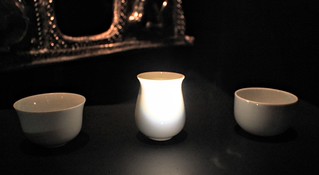 developed an object to hold liquid, and to drink from for millennia. As the “1660 Tea Cup Connoisseur Set” exhibited as part of the V&A exhibition entitled “What is Luxury?” points out, is how the small differences in the shape of vessel can impact taste. Highlighting the lip of a cup and how it can enhance aroma, texture or taste.
I tried to look at what is pleasant for me too, when drinking from a vessel, and found out how a small milk jug with a pouring lip is my favourite object to drink a hot tea from (especially a three cinnamon tea).


Also how profoundly different experience it is to drink fresh water from an Indian mug with a sucking lip rather than using just clean plain glass.


However, the emerging technology around ceramics and art interested me too. I’ve been so thankful I could see a 3D printer working at the British Ceramic Biennale.


I’m curious about playing with 3D software modelling and 3D printing, and incorporating this into my ceramic work, which than can speak of more contemporary ideas of practice and production.
An idea behind a body of work is important for me, as I want to explore or read concepts and arguments through an object.

Even an object gushing and bursting like vulcan full of magma can be considered a vessel; its own lava creating its walls, speaking of the formation process of clay and the Earth’s surface, as well as exciting and ever-changing human culture surrounding clay.

That’s why the objects created this 8 weeks want to speak about an impression: of a certain stability, like photographs of Bernd & Hilla Becher, of total steadiness and secureness, supported and weighted by their bases, fully functional with their angled lip and still they can develop in unpredicted way, like “many a slip…”
Like the documentary photography of Bechers, this is a snapshot of my progress throughout this first year of my degree.
Like the structures they photographed, strong and secure, but now all disassembled, demolished or not used; most of my work destroyed and reclaimed, my skills improved and changed.


 As a summer project before starting the degree we were asked to dig up some local clay for further testing, analysing and experimenting with.


 Ceramic Líška