Annie Turner (1958) is British ceramic artist notably known for her gridded ceramic vessels/sculptures. The hand-build stoneware structures explore the River Deben and surrounding landscape of Suffolk, closely linked to her family roots. The sculptures reflect the rivers tidal changes and seasonal rhythms by naturally warping and changing in the extreme heats of kiln.
Net, Hand built in red stoneware, white titanium glaze H 58 x W 50 x D 27 cm
For me it beautifully represents the time passing relating to physical space, and the stability or rather absence of stability and absence of permanence that time and space dimension brings.
They “echo the forms of its (the River Deben) associated man-made structures, such as sluices, ladders and nets. The surfaces of the works suggest processes of change and transformation, through erosion, decay, rusting, or accretion. The works reflect both the natural rhythms of the landscape and its fragility.”
I photographed and looked at photos of decaying and rusty industrial structures. The natural landscape of man’s security and stability through work.
I want to explore the natural landscape of humans, the feeling of stability, security and certainty.
Large scale, monumental pots with expressive surface marks while looking at traditional techniques of Chinese Porcelain from Jingdezhen.
Felicity Aylieff set up her ceramic studio in Jingdezhen, China – the world’s capital of porcelain, and ceramics.
This gave her first hand access to the knowledge of traditional ceramic making, which she is trying to translate “radically different, contemporary, with a clear personal voice” into her own practice.
In ‘Mapping Memory’ series, Felicity Aylieff is commissioning the local craftsmen to throw monumental vases from porcelain for her, on which she can create free-form brush marks, expressive lines and grids.
The marks and movement are well rehearsed from previous tests and practice to acquire “confidence, familiarity and integrity of mark.”
To create the rich dark ink blue, as well as soft and translucent, she is using Ming Blue – a mix of cobalt and iron oxides, diluted for different tones of blue.
Blue and White monumental Vase, 2011 ᅠ Porcelain, Glazed, Kang Qian Cobalt oxide 191 x 71 cms
Blue and White monumental Vase, 2011 ᅠ Glazed porcelain painted in cobalt blue 191 x 71 cms
Five Storey’s: Chinese Ladders – 3, 2009 ᅠ Glazed Porcelain, Cobalt Oxide. 269 x 50 x 50 cms
Visually, the surface marks resemble the skeletal parts of industrial cooling towers, chimneys or furnaces; just less structured, more expressive.
I tried my own version with inks, but trying for slightly more regular pattern of lines, resembling more structures on Bechers’ photographs.
However, I still tried to keep the free and expressive nature when using a brush.
Display of teapots in a Newport’s charity shop. Highly ornamental and narrative, but on its bottom they state that they are for decoration purposes only.
Bark teapot, a perfect replication of nature in clay.
A political teapot of cooperation. How a tiny teapot tries to represent movements and ideas in society.
Number of presentations and tutorials helping to clarify and refine our ideas, themes and direction of the project.
After the first presentation with Jennifer to Pete and year group, we realised our work is trying to encapsulate way too many ideas and themes: generation struggle and comparing it to previous generation, Staffordshire designs of the previous generation age, homelessness, current struggles of young adults, the post-financial crisis world.
They are similar and link in some ways, but it just became too cluttered.
Our set designs lacked experimentations and multiple stages of progress.
I proposed to look and direct our work on the ides of accommodation/containing and the lack of them, as I could see it as one of the common threads running through our broad ideas.
Jen didn’t object or suggested different directions, so I explored the ideas through the print workshop with Ann Gibbs which was a great place to experiment with the idea visually and practically; Ann giving me helpful feedback in the process.
This helped me to prepare for another presentation to Duncan, crystallising the new focused but still experimental and innovative directions.
I looked at teapot as allegorical object of domesticity and accommodation. Containing tea in its cavities.
And fallowing inability of these qualities, how the material and shape would change.
It has been exactly 8 weeks from receiving our SUBJECT brief titled “There’s many a slip”, exploring the ceramic practice of creating vessels.
It’s few days to our group tutorial as well as close to the Formative Assessment, giving us an idea on what mark we stand on, judging on skills, context and ideas. This will allow us to see and choose what direction we want the project to go in the Second Term.
I want this post to be my reflection on my ideas and exploration into a vessel, preparing me for the group tutorial to get most out of it.
The old English proverb that the brief is titled suggests that even if we know how something might turn up, and even if we are certain, something might still develop in an undesirable way.
It’s a great allegory to our first term of the degree where we are introduced to so many ideas and processes.
I managed to produced more waste (only recyclable of course) than functional objects; always pushing the clay when on the wheel to the point of collapse while developing my throwing skills, but at least I’m more confident at centering, pulling walls and creating shapes I desire.
As our first trip to the V&A Museum in London in the first, induction week revealed, there’s a huge number of ways to explore the subject of vessels; from just function or disfunction, to shape and size, colour and texture, narrative and impression or perhaps to nihilism and meaningfulness?
Besides, all the cultures developed an object to hold liquid, and to drink from for millennia. As the “1660 Tea Cup Connoisseur Set” exhibited as part of the V&A exhibition entitled “What is Luxury?” points out, is how the small differences in the shape of vessel can impact taste. Highlighting the lip of a cup and how it can enhance aroma, texture or taste.
I tried to look at what is pleasant for me too, when drinking from a vessel, and found out how a small milk jug with a pouring lip is my favourite object to drink a hot tea from (especially a three cinnamon tea).
Also how profoundly different experience it is to drink fresh water from an Indian mug with a sucking lip rather than using just clean plain glass.
However, the emerging technology around ceramics and art interested me too. I’ve been so thankful I could see a 3D printer working at the British Ceramic Biennale.
One of my 3D design attempts. A base/saucer for my vessels
I’m curious about playing with 3D software modelling and 3D printing, and incorporating this into my ceramic work, which than can speak of more contemporary ideas of practice and production.
An idea behind a body of work is important for me, as I want to explore or read concepts and arguments through an object.
Even an object gushing and bursting like vulcan full of magma can be considered a vessel; its own lava creating its walls, speaking of the formation process of clay and the Earth’s surface, as well as exciting and ever-changing human culture surrounding clay.
That’s why the objects created this 8 weeks want to speak about an impression: of a certain stability, like photographs of Bernd & Hilla Becher, of total steadiness and secureness, supported and weighted by their bases, fully functional with their angled lip and still they can develop in unpredicted way, like “many a slip…”
Like the documentary photography of Bechers, this is a snapshot of my progress throughout this first year of my degree.
Like the structures they photographed, strong and secure, but now all disassembled, demolished or not used; most of my work destroyed and reclaimed, my skills improved and changed.
Initial processing of my dug clay from Fforest Fawr near Tongwynlais, and shaping it for experiments and analysis.
After drying up my clay at home and braking it into smaller pieces, I brought the dried clay to the studio where I covered it with water to soak and brake the dried pieces up again.
Leaving it for a few days to sit and braking it up a bit more with hands I noticed how my substance is more like a sandy mud, than a clay.
I decided to screen it first through 30 mesh sieve to remove any larger sand, rocks and organic debris more easily, and then again through finer 40 mesh sieve.
My very short clay, most likely very high in organic compounds.
The process was very strenuous and incredibly smelly, the clay substance releasing powerful sewage odours, giving me more proof that what I have is a highly organic and sulphury substance with little clay in it.
When I removed all larger sand and organic debris with the sieves, I poured the wet mud onto a plaster bat to soak up excess water, and tried to wedge it into a one ball.
The substance felt rather sandy and as sand is a non-plastic part of a clay, I knew that my clay would be very short and lack plasticity.
This would make it difficult to shape my clay into tiles for further testing, therefore I decided to integrate some clay available in university to make it more plastic and malleable and see how the two clays would react.
There could be another option on how to separate and retreat the clay from my dug substance, using levigation. However, that was the more time consuming process and I already felt slightly behind with the task.
I decided to introduce the same amount of porcelain as my dug clay; choosing porcelain for it’s plasticity and whiteness; so that any colouring from my raw clay would be more noticeable.
Wedging the two clays together, the mixture was still too short for my likings, so I added a bit more porcelain.
Totally my clay mixture consists of 1296 grams of my raw dug clay and the same amount 1296 grams of porcelain with extra 300 grams, as the mixture was still too short. That is 44.81% of clay sourced in Fforest Fawr and 55.19% university’s porcelain.
I ended up with a more plastic and malleable clay, but also more porcelain than my dug clay.
I managed to shape the original raw clay at least into a ball of 100 grams, to test the water content in the dug substance.
The clay mixture was also shaped into a 100grams ball to see the weight difference compared to the pure raw clay, bone dry and then bisque fired; suggesting the amount of water as well as chemically bonded water in the clays.
The test tiles from my porcelain and raw clay mix will be fired to different temperatures raging from just bone dry, biscuit fired to 1280°C reduction.
This will demonstrate changes across the different temperatures as well as the shrinkage rate, when measuring the 10cm long line marked on the tiles.
After drying for few weeks and then weighting the 100 grams balls again, the difference in water content was 33.3 grams for raw clay and 26.1 grams for clay mixture with porcelain.
As a summer project before starting the degree we were asked to dig up some local clay for further testing, analysing and experimenting with.
Also undertaking a short research into how the area was used before for production; socio-historic timeframe, history and geology.
I dug up my clay in one of my favourite explorational places around Cardiff, where I tend to go on a short bicycle trip to relax and explore. Fforest Fawr with the Castle Coch nesting nearby, above the village of Tongwynlais.
Landscape – Site of Specific Scientific Interest – the woods surrounding the Castle Coch know as the Taff Gorge complex, are amongst the most westerly natural beech woodlands in the British Isles. … The area has unusual rock outcrops, which show the point where Devonian Old Red Sandstone and Carboniferous Limestone beds meet.
Screenshot of my location from Geology of Britain viewer on British Geological Survey website.
In the area of Tongwynlais, coal, limestone and iron ore deposits could be found in close proximity to each other, allowing creation of early industrial landscape for iron production.
The mine entrances known as “The Three Arches” (or The Three Bears Cave) descending of up to 20 metres deep into the thick bedded limestone, is still visible, but fenced. The walls of the cave reveal how the mines were carved, with cylindrical features; former drill holes for dynamite to blow open the seam.
The iron works ceased in 1879 due to competition of surrounding towns using cheaper methods of extraction.
Looking at British Geological Survey’ viewer, I could pinpoint the location of where I dug the clay substance and look at the geological composition of the area.
Unfortunately, there’s no specific information on surface composition of exactly where I dug the clay; but “Alluvium – clay and slit,…” deposits very close-by in the village.
The bedrock of the forest area is sedimentary Dolomitic Limestone, formed about 326-359 million years ago.
Me trying to dig some clay.
Equipped with only a small frog trowel, big buckets and a dear friend driving me to the chosen location, I enthusiastically set out for the investigational task.
With the advice from the letter stating the summer project, we’ve found a small stream in the forest. Trying to dig approximately 40cm deep before excavating the clay proved to be challenging without a proper spade. So after about 20cm of excavation I couldn’t go any deeper so collected any, at least a bit plastic seeming substances.
Carved wooden sculpture next to the mine entrance, also known as the Three Bears Cave.Castle Coch next to the Fforest Fawr, with my brother in the foreground.
Back home I spread the mud substance, removed any larger rocks, twigs and leaves and let it dry. In the process a strong smell of mainly sulphur creeped across my house.
While undergoing intense workshop into the basics of throwing and turning in the first term, I started to lean to and try to repeat some similar shapes in particular – trapezoid, a cooling tower shape or a hyperboloid structure.
To aid and direct the objects I am producing during the first term’s project, I’m researching work of Bernd (20.08.1931-22.06.2007) and Hilla Becher (2.09.1934-10.10.2015); as well as looking at other images, and my drawings emerging from them.
From series – Cooling towers, Germany 1964-1993 by Bernd and Hilla Becher
Bernd and Hilla Becher are an artist duo documenting German’s disappearing industrial architecture in 1959.
Their work is presenting engineer’s structures, like sculptures – monuments of strength and stability; they are sincere and objective-less: documenting and capturing the present, which can disappear (and which did – disassembly and moving factories and industries to Asia).
Like a technical drawing, showing the great skills in photograph-making, they are trying to capture the image with no distortion, and brimming with information.
That’s why their photographs are sometimes criticised as cold and ‘inartistic’, especially in the time when art photographers wanted their pictures with an effect – high contrast, soft focus, etc.
Bernd and Hilla Becher Gas-holders Germany, Belgium, France, Britain, USA, 1966–93 Each 40 x 30 cmBernd and Hilla Becher Winding towers Germany, Belgium, France, 1965–98 Each 40 x 30 cm
Cooling Towers, 1983 Gelatin silver prints Twelve parts, each: 20 x 16 in. (50.8 x 40.6 cm) Gerald S. Elliott Collection 1995.31.a–l
I created a number of quick sketches from these photographs, looking at the overall shape and pattern structure within.
I want these to direct my work into similar shapes, patterns and concepts.
As the photographs being a sincere documentation of present mastery, my work will be at the end of this first brief a honest snapshot of my development and mastery of the craft.
The ideas of stability and the present also interest me, as well as the historical significance of moving most of the industry from Europe to Asia and how the economic changes impacted today’s population of the West.
These are my first thrown objects this term, in Ash White, turned and most of them lightly burnished or scratched.
They can stack up to create a new structure, but they doesn’t fit well.
I do treat them as first experimentations, practice maquettes and first stages in my development of both practice and concept.
I want to be more consistent in the shape, to translate the stability and industrial power. The stacking up element to create new sculptural pieces from them, securely fitting into each other. And the overall quality of the object: cleaner finish, mostly with the rim; walls consistency and overall balance of the weight.
In the near future I will look at surface decoration: printing, scratching, colour, glazes, pattern, metal features.
In our weekly ‘Material Alchemy’ lecture we were encourage to look into clay suppliers and the description for their clays.
One of the most widely used clays in the CSAD are from POTCLAYS. Established in 1932 as a clay mining company in Brownhills, South Staffordshire; it now creates premium-quality clay bodies with a worldwide reputation.
The supplier has very good website with large selection of products for potters, however the only technical information for their clays is the recommended firing temperature; which for the clays used in CSAD is 1150°C – 1290°C for Buff Stoneware and 1160°C – 1300°C for White St Thomas.
Valentine Clays is another British family manufacturer of clays, from which the CSAD gets its Red Terracotta clays.
The website also states the basic properties such as texture, appropriate use, colour and firing range:1080°C – 1180°C
I haven’t manage to find any more first hand manufacturers of clay with good website and online shop.
However COMMERCIAL CLAY LTD is another manufacturer from Stoke-on-Trend established in 1982. Its old-fashioned website shows all of their clays with some data sheets information.
I searched for suppliers in Slovakia too, finding only one KERAMIKA BIELA HORA s.r.o. manufacturing a multi-purpose clay, however the website doesn’t even inform if it’s stoneware or earthenware.
Most of the suppliers buy the clays produced in Germany or other European countries.
Local clay depositories and previous mining activity such as in Pozdisovce has apparently been closed, mostly due to low competitiveness and demand, as well as bad business practices from Communist era.


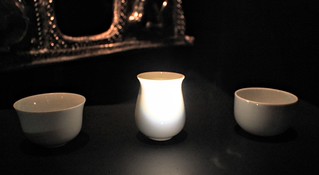 developed an object to hold liquid, and to drink from for millennia. As the “1660 Tea Cup Connoisseur Set” exhibited as part of the V&A exhibition entitled “What is Luxury?” points out, is how the small differences in the shape of vessel can impact taste. Highlighting the lip of a cup and how it can enhance aroma, texture or taste.


 As a summer project before starting the degree we were asked to dig up some local clay for further testing, analysing and experimenting with.


 data sheets information.
 Ceramic Líška